
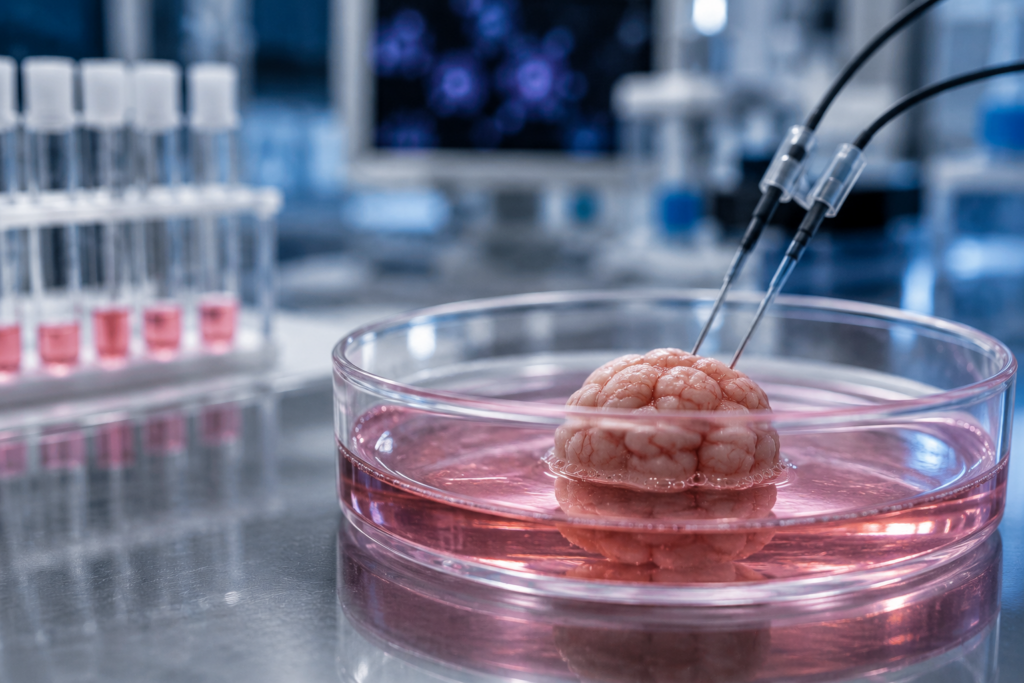
Lab-Grown Mini-Brains: Human brain organoids have historically struggled to survive past early embryonic development in laboratory settings, with the previous survival record capped at roughly 23 months. In a study published in Nature, researchers at Harvard University overcame this wall by engineering an optimized culture medium tailored to support spontaneous electrical firing. This breakthrough enabled peppercorn-sized clusters of over one million cortical cells to remain viable and active for more than five years.
Ticking by Epigenetic Design
Rather than staying locked in early fetal stages, the long-lived mini-brains steadily matured in sync with a normal human lifespan. Single-cell sequencing and whole-genome methylation profiling confirmed that chemical modifications on DN epigenetic age clocks, closely matched the organoids’ actual calendar age in the dish ($r = 0.88–0.90$). Over the multi-year timeline, the clusters systematically developed mature synapses, specialized glial cells, and postnatal gene expression patterns.
Also Read | AI just designed new viruses, and biology may never be the same
The Developmental Time Warp
To test whether these cells actively tracked their age or merely reacted to passive environmental cues, researchers transplanted older progenitor cells into young, developing organoids. Instead of resetting their behavior to match their new surroundings, the older cells bypassed early phases and directly produced late-stage neurons. This cellular memory showed that human brain tissue houses a self-contained, cell-intrinsic clock capable of remembering elapsed developmental time.
Also Read | DRC Ebola outbreak: 2,325 dead as confirmed cases rise to 4,945
Opening the Postnatal Black Box
Human brain development spans nearly two decades, leaving late-stage maturation notoriously difficult to study in standard animal models. Maintaining brain organoids across multi-year spans provides an unprecedented experimental platform for exploring late-onset neuropsychiatric conditions like schizophrenia and autism, modeling age-related neurodegenerative diseases, and understanding how our brains pace their own growth.