
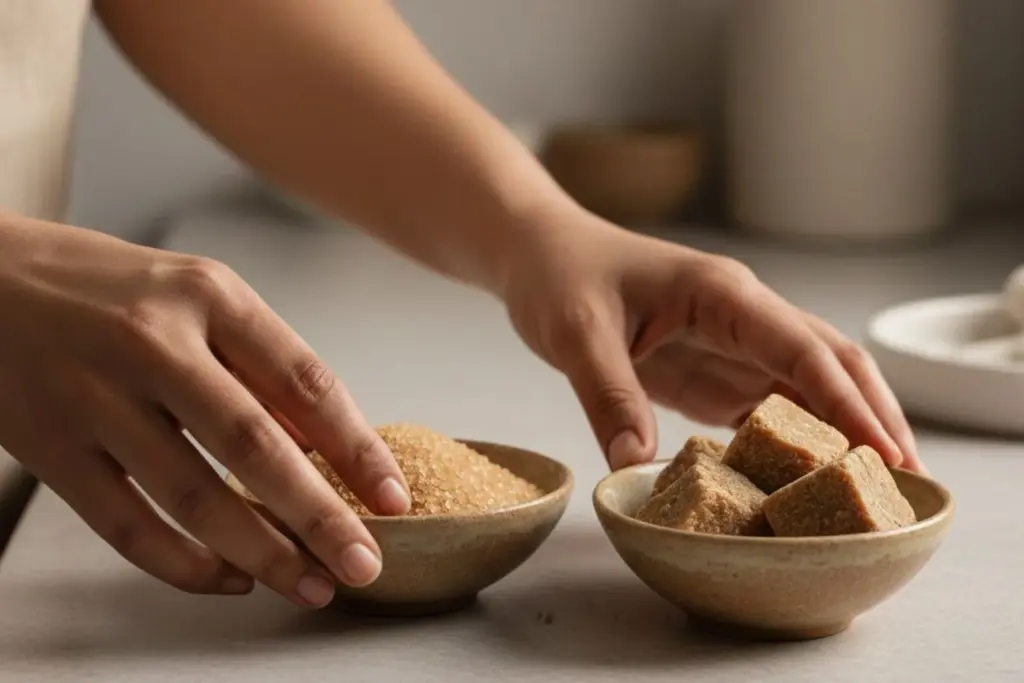
Are brown sugar and jaggery healthy: Sugar slips into our day more easily than we realise: one spoon in chai, a biscuit with coffee, a sweet after lunch, a dessert on weekends. And lately, a common question keeps coming up: Is white sugar really that harmful? And if it is, do “healthier” options like brown sugar or jaggery (gur) actually make a difference?
Before choosing a sweetener based on colour or tradition, it helps to understand what each one truly is.
Also Read | Which natural sweeteners are healthier than sugar? 5 options to try
What is brown sugar?
Brown sugar isn’t a completely different kind of sugar. In most cases, it’s simply refined white sugar with molasses added back. Molasses is the thick, dark syrup left behind during the sugar refining process. When it’s mixed into white sugar again, it creates that familiar brown colour, softer texture, and slightly caramel-like flavour.
You’ll usually find two common varieties:
- Light brown sugar (less molasses, milder flavour)
- Dark brown sugar (more molasses, deeper colour and stronger taste)
Even though it looks more “natural,” brown sugar is still very close to white sugar in terms of calories and how it affects the body.
What is jaggery (gur)?
Jaggery is a traditional sweetener made by concentrating sugarcane juice (or palm sap). Instead of being heavily refined into pure crystals, the juice is boiled for a long time until it thickens, then cooled and set into blocks, granules, or powder.
Because it goes through less processing, jaggery often retains small amounts of naturally occurring minerals and compounds from the original juice. That’s why it has a deeper, richer taste, almost like caramel or toffee, and why it’s commonly used in Indian sweets, winter snacks, and warm drinks.
| Feature | White Sugar | Brown Sugar | Jaggery |
| Processing | Highly refined, all molasses removed | White sugar with molasses added back | Minimal processing, made from sugarcane juice or palm sap |
| Calories (per 100 grams) | ~400 | ~380 | ~380 |
| Nutrients | None (empty calories) | Trace calcium, iron, potassium | Contains iron, magnesium, potassium, and antioxidants |
| Taste | Plain, neutral | Slightly caramel-like | Rich, earthy, caramel-like |
| Texture or form | Fine crystals | Moist, soft crystals | Solid blocks, powder, or liquid |
| Blood Sugar | High (spikes blood sugar fast) | High (almost the same as white sugar) | High (slightly slower but still raises blood sugar) |
| Health factor | Least healthy | Slightly better than white sugar | Better than both, but still |
Is brown sugar healthier than white sugar?
Because it contains molasses, brown sugar has trace amounts of minerals. But nutritionally, it behaves very similarly to white sugar. The calories are almost the same, and it can still spike blood sugar. In simple words, the colour changes, but the impact on the body doesn’t change much.
Is jaggery healthier than white sugar?
Jaggery is less processed and tends to retain more naturally occurring minerals like iron, magnesium, and potassium, along with some antioxidant compounds. That makes it a better option than refined sugar from a processing point of view. But it’s still a concentrated sweetener, carrying similar calories and can raise blood sugar quickly, especially if you use it freely.
So yes, jaggery is often the better pick, but “better” doesn’t mean unlimited.

Tips to use brown sugar and jaggery wisely
- Swapping sugar for jaggery doesn’t help if the quantity doubles.
- Reduce the total sweetness. In baking or tea, try cutting the sweetener by 20–25%; most people barely notice.
- Use jaggery where it adds value. It works best in traditional foods like laddoos, chikkis, or herbal teas, where the flavour actually shines.
- Let fruit do the sweetening first. Dates, bananas, raisins, or stewed fruit can reduce the need for added sweeteners.
Also Read | Can people with diabetes eat dates?
Brown sugar is essentially refined sugar with a small twist. Jaggery is less processed and contains more minerals, so it’s usually the better choice of the two. But both are still sugars, and in excess, both can contribute to weight gain, insulin spikes, and high blood sugar. Enjoy sweets, but treat jaggery and brown sugar as “less processed,” not “healthy foods.”