

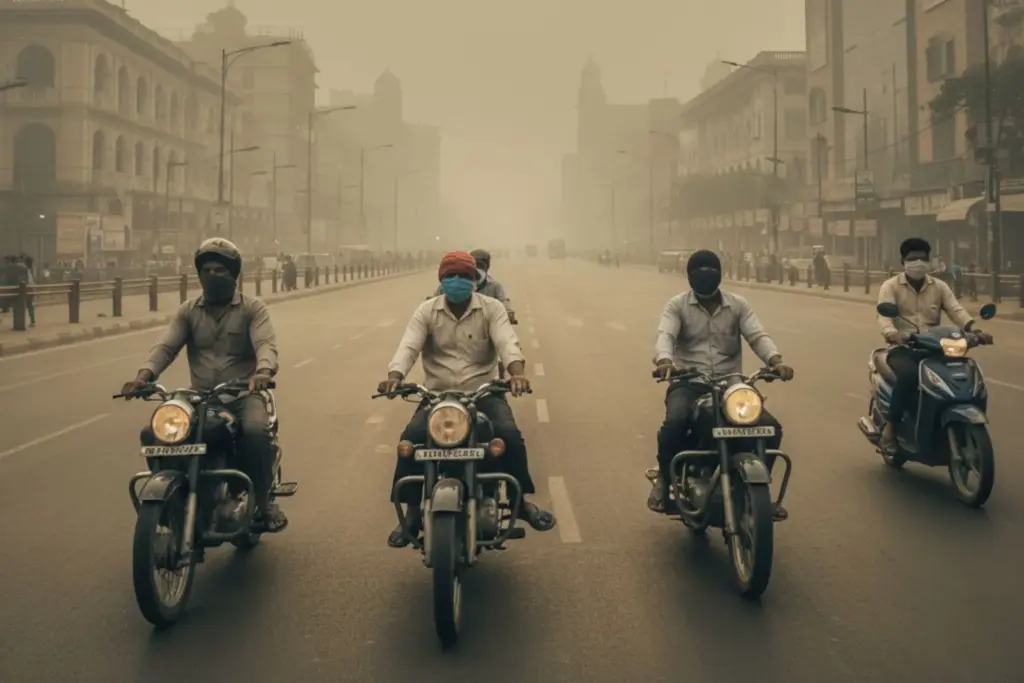
Delhi pollution: Men travelling through Delhi’s congested streets are breathing in significantly more pollution than women, a new study has revealed.
The research, which tracked air quality patterns from 2019 to 2023, measured how much particulate matter actually settles in people’s lungs rather than just the pollution levels in the air.
Scientists from Netaji Subhas University of Technology and an environmental consultancy in Noida examined data from 39 monitoring stations throughout the capital.
Also Read | No conclusive data linking deaths exclusively to air pollution: Govt
Their findings show that men absorb about 1.4 times more PM2.5 particles and 1.34 times more PM10 particles than women while seated. When walking, men inhale roughly 1.2 times more of both pollutants compared to women.
Researchers attribute this gap to men’s larger lung capacity and breathing volume, which pulls more contaminated air into their respiratory systems.
The study delivers sobering news for all Delhi residents. People living in the capital have particulate matter deposits in their lungs approximately 10 times what India’s air quality standards would permit. Against World Health Organization benchmarks, the figures are even starker, nearly 40 times the acceptable threshold.
India allows 60 micrograms of PM2.5 and 100 micrograms of PM10 per cubic meter daily. WHO guidelines set tighter limits at 15 and 45 micrograms, respectively.
Walking proved far more hazardous than sitting, with lung deposits two to three times higher among pedestrians. Men on foot faced the worst exposure, followed by women walking, then seated men and seated women.
Evening commutes emerged as particularly dangerous. Lung deposits jumped 39 per cent for PM2.5 and 23 per cent for PM10 during evening hours versus morning travel. Researchers point to increased traffic and atmospheric conditions that trap emissions near ground level. Festival celebrations also spike pollution dramatically. On Diwali nights, particulate deposits nearly doubled, with elevated levels persisting for days afterwards.
Industrial zones recorded the highest pollution deposits, with commercial areas close behind. Central Delhi neighbourhoods with more trees and parks showed lower exposure levels.
The 2020 coronavirus lockdown offered an unexpected control experiment. With traffic and industrial operations largely halted, lung deposits plummeted 60 to 70 per cent across multiple areas, proof that reducing emissions can rapidly improve public health.
The researchers emphasise that pedestrians and outdoor workers face the greatest danger, combining physical exertion with extended time in polluted air.